找回密碼
 To register

QQ登錄

只需一步,快速開(kāi)始

掃一掃,訪(fǎng)問(wèn)微社區(qū)

打印 上一主題 下一主題

Titlebook: Recognition Receptors in Biosensors; Mohammed Zourob Book 2010 Springer-Verlag New York 2010 Biomedical Engineering.Biophysics.Biosensor.B

[復(fù)制鏈接]
查看: 25151|回復(fù): 56
樓主
發(fā)表于 2025-3-21 16:05:56 | 只看該作者 |倒序?yàn)g覽 |閱讀模式
書(shū)目名稱(chēng)Recognition Receptors in Biosensors
編輯Mohammed Zourob
視頻videohttp://file.papertrans.cn/825/824056/824056.mp4
概述Includes supplementary material:
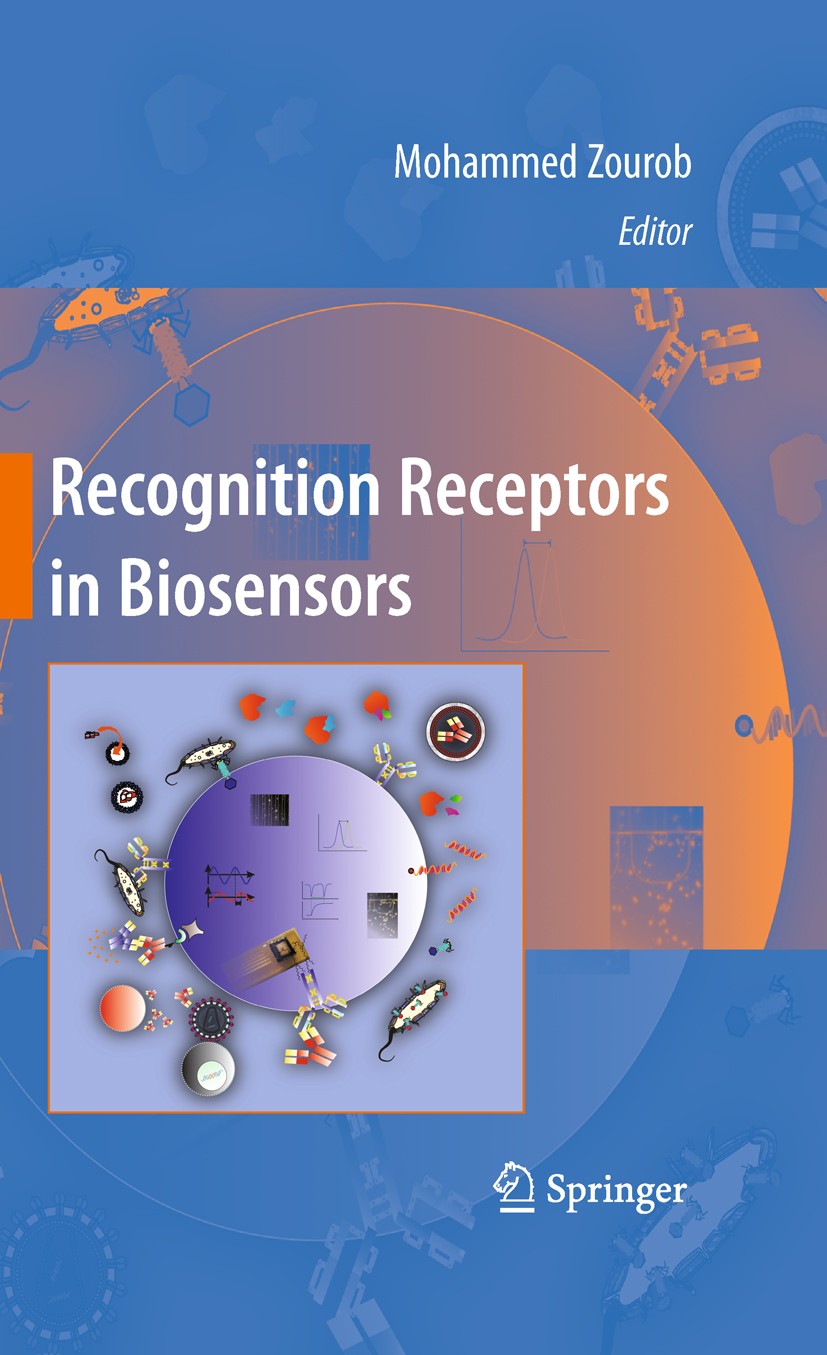
圖書(shū)封面Titlebook: Recognition Receptors in Biosensors;  Mohammed Zourob Book 2010 Springer-Verlag New York 2010 Biomedical Engineering.Biophysics.Biosensor.B
描述Recognition receptors play a key role in the successful implementation of chemical and biosensors. Molecular recognition refers to non-covalent speci?c binding between molecules, one of which is typically a macromolecule or a molecular assembly, and the other is the target molecule (ligand or analyte). Biomolecular recognition is typically driven by many weak interactions such as hydrogen bo- ing, metal coordination, hydrophobic forces, van der Waals forces, pi-pi interactions and electrostatic interaction (due to permanent charges, dipoles, and quadrupoles) the polarization of charge distributions by the interaction partner leading to ind- tion and dispersion forces, and Pauli-exclusion-principle-derived inter-atomic repulsion, and a strong, “attractive” force arising largely from the entropy of the solvent and termed the hydrophobic effect. In recent years, there has been much progress in understanding the forces that drive the formation of such complexes, and how these forces are relate to the physical properties of the interacting molecules and their environment allows rational design of molecules and materials that interact in speci?c and desired ways. This book presents a sig
出版日期Book 2010
關(guān)鍵詞Biomedical Engineering; Biophysics; Biosensor; Biosensors; Microarray; Peptide; Recognition Receptors; Zour
版次1
doihttps://doi.org/10.1007/978-1-4419-0919-0
isbn_softcover978-1-4939-3940-4
isbn_ebook978-1-4419-0919-0
copyrightSpringer-Verlag New York 2010
The information of publication is updating

書(shū)目名稱(chēng)Recognition Receptors in Biosensors影響因子(影響力)


書(shū)目名稱(chēng)Recognition Receptors in Biosensors影響因子(影響力)學(xué)科排名


書(shū)目名稱(chēng)Recognition Receptors in Biosensors網(wǎng)絡(luò)公開(kāi)度


書(shū)目名稱(chēng)Recognition Receptors in Biosensors網(wǎng)絡(luò)公開(kāi)度學(xué)科排名


書(shū)目名稱(chēng)Recognition Receptors in Biosensors被引頻次


書(shū)目名稱(chēng)Recognition Receptors in Biosensors被引頻次學(xué)科排名


書(shū)目名稱(chēng)Recognition Receptors in Biosensors年度引用


書(shū)目名稱(chēng)Recognition Receptors in Biosensors年度引用學(xué)科排名


書(shū)目名稱(chēng)Recognition Receptors in Biosensors讀者反饋


書(shū)目名稱(chēng)Recognition Receptors in Biosensors讀者反饋學(xué)科排名


單選投票, 共有 1 人參與投票
 

0票 0.00%

Perfect with Aesthetics


0票 0.00%

Better Implies Difficulty


0票 0.00%

Good and Satisfactory


1票 100.00%

Adverse Performance


0票 0.00%

Disdainful Garbage

您所在的用戶(hù)組沒(méi)有投票權(quán)限
沙發(fā)
發(fā)表于 2025-3-21 21:34:43 | 只看該作者
r recognition refers to non-covalent speci?c binding between molecules, one of which is typically a macromolecule or a molecular assembly, and the other is the target molecule (ligand or analyte). Biomolecular recognition is typically driven by many weak interactions such as hydrogen bo- ing, metal
板凳
發(fā)表于 2025-3-22 04:21:27 | 只看該作者
Surface Sensitization Techniques and Recognition Receptors Immobilization on Biosensors and Microarr
地板
發(fā)表于 2025-3-22 07:00:19 | 只看該作者
5#
發(fā)表于 2025-3-22 09:16:32 | 只看該作者
Carbohydrates as Recognition Receptors in Biosensing Applications
6#
發(fā)表于 2025-3-22 14:37:49 | 只看該作者
7#
發(fā)表于 2025-3-22 17:38:39 | 只看該作者
8#
發(fā)表于 2025-3-22 22:46:30 | 只看該作者
9#
發(fā)表于 2025-3-23 03:37:16 | 只看該作者
10#
發(fā)表于 2025-3-23 08:48:32 | 只看該作者
 關(guān)于派博傳思  派博傳思旗下網(wǎng)站  友情鏈接
派博傳思介紹 公司地理位置 論文服務(wù)流程 影響因子官網(wǎng) 吾愛(ài)論文網(wǎng) 大講堂 北京大學(xué) Oxford Uni. Harvard Uni.
發(fā)展歷史沿革 期刊點(diǎn)評(píng) 投稿經(jīng)驗(yàn)總結(jié) SCIENCEGARD IMPACTFACTOR 派博系數(shù) 清華大學(xué) Yale Uni. Stanford Uni.
QQ|Archiver|手機(jī)版|小黑屋| 派博傳思國(guó)際 ( 京公網(wǎng)安備110108008328) GMT+8, 2025-10-15 01:44

Copyright © 2001-2015 派博傳思   京公網(wǎng)安備110108008328 版權(quán)所有 All rights reserved
快速回復(fù) 返回頂部 返回列表
奎屯市| 耿马| 岗巴县| 株洲县| 瑞安市| 赤峰市| 讷河市| 昌邑市| 洱源县| 剑川县| 大新县| 屏边| 乡宁县| 平利县| 西乌| 鹿泉市| 博乐市| 琼中| 广州市| 九江市| 搜索| 东乡县| 嫩江县| 柯坪县| 苏尼特右旗| 响水县| 古交市| 墨竹工卡县| 和林格尔县| 永登县| 普兰店市| 永吉县| 临泉县| 垫江县| 马鞍山市| 新干县| 广德县| 山阴县| 昌平区| 盈江县| 新晃|