找回密碼
 To register

QQ登錄

只需一步,快速開始

掃一掃,訪問微社區(qū)

打印 上一主題 下一主題

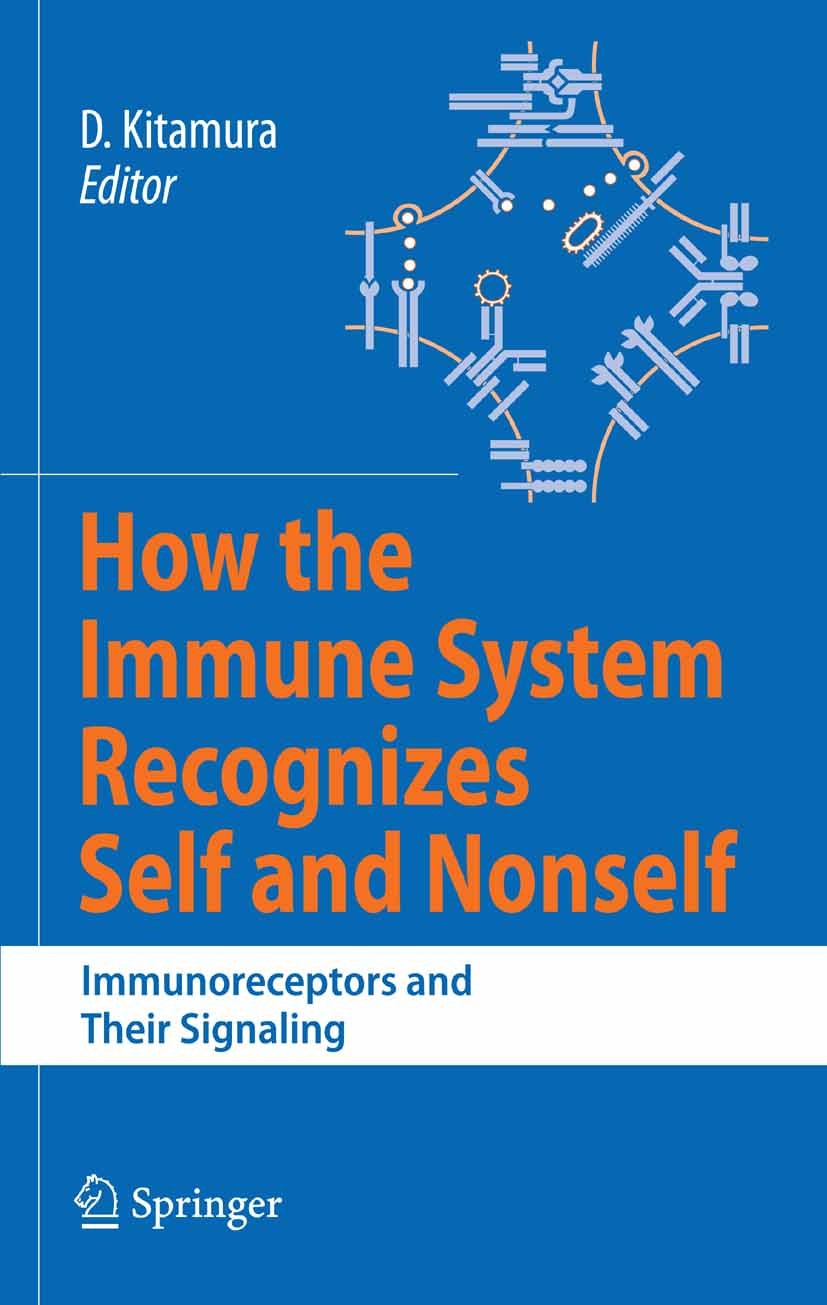
Titlebook: How the Immune System Recognizes Self and Nonself; Immunoreceptors and Daisuke Kitamura (Professor) Book 2008 Springer-Verlag Tokyo 2008 V

[復(fù)制鏈接]
查看: 18946|回復(fù): 40
樓主
發(fā)表于 2025-3-21 19:06:11 | 只看該作者 |倒序?yàn)g覽 |閱讀模式
書目名稱How the Immune System Recognizes Self and Nonself
副標(biāo)題Immunoreceptors and
編輯Daisuke Kitamura (Professor)
視頻videohttp://file.papertrans.cn/429/428737/428737.mp4
圖書封面Titlebook: How the Immune System Recognizes Self and Nonself; Immunoreceptors and  Daisuke Kitamura (Professor) Book 2008 Springer-Verlag Tokyo 2008 V
描述How do you discriminate yourself from other people? This question must sound odd to you since you easily recognize others at a glance and, without any effort, would not mistake them for yourself. However, it is not always easy for some people to discriminate themselves from others. For example, patients with schi- phrenia often talk with “others” living inside themselves. Thus it is likely that n- mally your brain actively recognizes and remembers the information belonging to yourself and discriminates it from the information provided by others, although you are not conscious of it. This brain function must have been particularly important for most animals to protect their lives from enemies and for species to survive through evolution. Similarly, higher organisms have also acquired their immune system through evolution that discriminates nonself pathogens and self-body to protect their lives from pathogens such as bacteria or viruses. The brain system may distinguish integrated images of self and nonself created from many inputs, such as vision, sound, smell, and others. The immune system recognizes and distinguishes a variety of structural features of self and nonself components.
出版日期Book 2008
關(guān)鍵詞Viruses; autoimmune disease; bacteria; cell; diseases; immune system; immunity; immunoglobulin; infection; ly
版次1
doihttps://doi.org/10.1007/978-4-431-73884-8
isbn_softcover978-4-431-99831-0
isbn_ebook978-4-431-73884-8
copyrightSpringer-Verlag Tokyo 2008
The information of publication is updating

書目名稱How the Immune System Recognizes Self and Nonself影響因子(影響力)


書目名稱How the Immune System Recognizes Self and Nonself影響因子(影響力)學(xué)科排名


書目名稱How the Immune System Recognizes Self and Nonself網(wǎng)絡(luò)公開度


書目名稱How the Immune System Recognizes Self and Nonself網(wǎng)絡(luò)公開度學(xué)科排名


書目名稱How the Immune System Recognizes Self and Nonself被引頻次


書目名稱How the Immune System Recognizes Self and Nonself被引頻次學(xué)科排名


書目名稱How the Immune System Recognizes Self and Nonself年度引用


書目名稱How the Immune System Recognizes Self and Nonself年度引用學(xué)科排名


書目名稱How the Immune System Recognizes Self and Nonself讀者反饋


書目名稱How the Immune System Recognizes Self and Nonself讀者反饋學(xué)科排名


單選投票, 共有 1 人參與投票
 

1票 100.00%

Perfect with Aesthetics


0票 0.00%

Better Implies Difficulty


0票 0.00%

Good and Satisfactory


0票 0.00%

Adverse Performance


0票 0.00%

Disdainful Garbage

您所在的用戶組沒有投票權(quán)限
沙發(fā)
發(fā)表于 2025-3-21 21:06:37 | 只看該作者
板凳
發(fā)表于 2025-3-22 01:30:13 | 只看該作者
https://doi.org/10.1007/978-4-431-73884-8Viruses; autoimmune disease; bacteria; cell; diseases; immune system; immunity; immunoglobulin; infection; ly
地板
發(fā)表于 2025-3-22 06:59:04 | 只看該作者
Recognition of Pathogens: Toll-Like Receptors, Each TLR has its intrinsic signaling pathway and induces specific biological responses against microorganisms. Here, we discuss the rapidly accumulating members of the TLR family, their functions and signaling mechanisms.
5#
發(fā)表于 2025-3-22 10:09:43 | 只看該作者
6#
發(fā)表于 2025-3-22 14:11:46 | 只看該作者
Book 2008 effort, would not mistake them for yourself. However, it is not always easy for some people to discriminate themselves from others. For example, patients with schi- phrenia often talk with “others” living inside themselves. Thus it is likely that n- mally your brain actively recognizes and remember
7#
發(fā)表于 2025-3-22 20:38:27 | 只看該作者
Strategies of Natural Killer (NK) Cell Recognition and Their Roles in Tumor Immunosurveillance, “missing-self recognition” (via major histocompatibility complex [MHC] class I) (.), the identification of inhibitory cell surface receptors that modulate NK cell activation (via Immunoreceptor Tyrosine-based Inhibition Motifs: ITIM) (.) or the “stress-induced self recognition” (via NKG2D) (.) .. T
8#
發(fā)表于 2025-3-22 22:03:15 | 只看該作者
Recent Progress on Paired Immunoglobulin-Like Receptors,-like receptor-A and PIR-B are cell surface glycoproteins with very similar extracellular regions (>92% homology) containing six Ig-like domains, but with structurally and functionally distinct transmembrane and cytoplasmic regions (see .). There are multiple PIR-A isoforms (>6), each encoded by a d
9#
發(fā)表于 2025-3-23 03:28:04 | 只看該作者
10#
發(fā)表于 2025-3-23 06:01:08 | 只看該作者
How Do T Cells Discriminate Self from Nonself?,olecular patterns,” it should be stressed that in the case of bacteria these ligands are not exclusively derived from pathogens. Therefore, sensors of innate immunity such as Toll-like receptors do not distinguish microbial commensals from pathogens.
 關(guān)于派博傳思  派博傳思旗下網(wǎng)站  友情鏈接
派博傳思介紹 公司地理位置 論文服務(wù)流程 影響因子官網(wǎng) 吾愛論文網(wǎng) 大講堂 北京大學(xué) Oxford Uni. Harvard Uni.
發(fā)展歷史沿革 期刊點(diǎn)評(píng) 投稿經(jīng)驗(yàn)總結(jié) SCIENCEGARD IMPACTFACTOR 派博系數(shù) 清華大學(xué) Yale Uni. Stanford Uni.
QQ|Archiver|手機(jī)版|小黑屋| 派博傳思國際 ( 京公網(wǎng)安備110108008328) GMT+8, 2025-10-9 18:23

Copyright © 2001-2015 派博傳思   京公網(wǎng)安備110108008328 版權(quán)所有 All rights reserved
快速回復(fù) 返回頂部 返回列表
大石桥市| 长宁县| 珲春市| 青岛市| 襄汾县| 施甸县| 雷山县| 翁牛特旗| 棋牌| 杭州市| 中山市| 安福县| 霍城县| 通化市| 光山县| 九台市| 孝感市| 西乌珠穆沁旗| 宁德市| 南安市| 甘孜县| 理塘县| 青浦区| 和田市| 宁陕县| 开远市| 繁昌县| 封开县| 高唐县| 太康县| 海丰县| 伊金霍洛旗| 庆云县| 两当县| 南开区| 同江市| 平远县| 乌恰县| 巩留县| 济宁市| 东海县|