找回密碼
 To register

QQ登錄

只需一步,快速開始

掃一掃,訪問微社區(qū)

打印 上一主題 下一主題

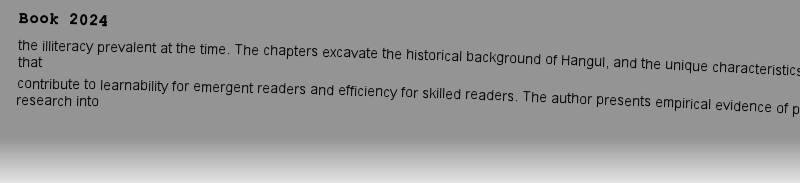
Titlebook: Analyzing the Korean Alphabet; The Science of Hangu Hye K. Pae Book 2024 The Editor(s) (if applicable) and The Author(s), under exclusive l

[復(fù)制鏈接]
樓主: 柳條筐
11#
發(fā)表于 2025-3-23 13:11:50 | 只看該作者
12#
發(fā)表于 2025-3-23 14:51:10 | 只看該作者
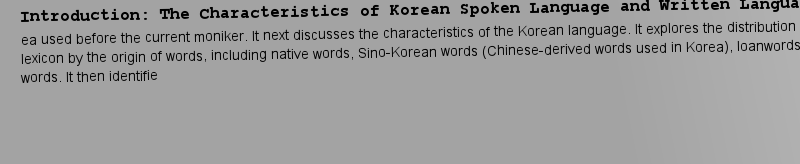
https://doi.org/10.1007/978-1-4615-4957-4Hangul is presented. All these models involve sequential and quasi-sequential orthography–phonology–morphology construal for reading, which is different from that for spelling. A model for spelling needs to be developed as empirical evidence accumulates in the interaction between the Korean language
13#
發(fā)表于 2025-3-23 21:10:19 | 只看該作者
14#
發(fā)表于 2025-3-24 02:00:03 | 只看該作者
15#
發(fā)表于 2025-3-24 04:43:42 | 只看該作者
16#
發(fā)表于 2025-3-24 10:06:55 | 只看該作者
Pathway to the Korean Alphabetrea and moves on to how Chinese characters were not suitable as a writing system for Koreans to such a degree that they could not encode the Korean language properly. The birth of the Korean alphabet was possible due to King Sejong’s sympathy for ordinary people’s challenges with their illiteracy (a
17#
發(fā)表于 2025-3-24 13:54:09 | 只看該作者
Beyond the Invention: Trajectory, Modern Use, and Global Affordancesthe Korean alphabet after its birth. As opposed to King Sejong’s vision, the writing system was not welcomed by ruling elites in the fifteenth century and onward, who viewed Chinese characters as .. It surveys the sociocultural context of the JoSeon dynasty and the alphabet usage primarily by ordina
18#
發(fā)表于 2025-3-24 17:19:53 | 只看該作者
19#
發(fā)表于 2025-3-24 22:18:51 | 只看該作者
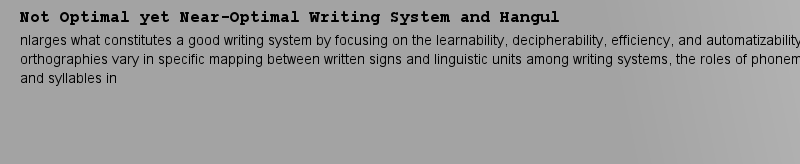
Orthographic and Phonological Representations in HangulKorean alphabet in the fifteenth century, King Sejong not only implemented cosmological concepts (the trinity of the universe—the heavens, earth, and humankind) into the design of vowels (.)?and the articulatory organs into consonants?(.or .), but also employed systematic stroke-addition rules to ex
20#
發(fā)表于 2025-3-24 23:42:16 | 只看該作者
From the Phonemic Principle to the Morphophonological Principleh century, grapheme–phoneme correspondences were regular and consistent with near-perfect fidelity, which promoted scriptal learnability. While spoken language had gradually changed from the fifteenth century through the nineteenth century, however, the phonographic script could not keep abreast wit
 關(guān)于派博傳思  派博傳思旗下網(wǎng)站  友情鏈接
派博傳思介紹 公司地理位置 論文服務(wù)流程 影響因子官網(wǎng) 吾愛論文網(wǎng) 大講堂 北京大學(xué) Oxford Uni. Harvard Uni.
發(fā)展歷史沿革 期刊點評 投稿經(jīng)驗總結(jié) SCIENCEGARD IMPACTFACTOR 派博系數(shù) 清華大學(xué) Yale Uni. Stanford Uni.
QQ|Archiver|手機版|小黑屋| 派博傳思國際 ( 京公網(wǎng)安備110108008328) GMT+8, 2025-10-8 13:07
Copyright © 2001-2015 派博傳思   京公網(wǎng)安備110108008328 版權(quán)所有 All rights reserved
快速回復(fù) 返回頂部 返回列表
淮滨县| 巢湖市| 河津市| 灵璧县| 甘泉县| 昭平县| 慈溪市| 肇庆市| 灵丘县| 高雄市| 芜湖市| 静乐县| 祁连县| 菏泽市| 保亭| 修水县| 黄龙县| 台东县| 灵川县| 甘肃省| 巴彦淖尔市| 泾川县| 樟树市| 叶城县| 如皋市| 稻城县| 易门县| 丰原市| 沛县| 嵊泗县| 五华县| 宜昌市| 从化市| 沾化县| 滕州市| 宜川县| 灵川县| 丽江市| 罗平县| 施秉县| 汨罗市|